May 7, 2026
Precision under pressure
How the HEIDENHAIN Corporate Group is advancing motion control in the marine industry
Marine environments leave no room for compromise.
From offshore vessels in unpredictable conditions to port-side systems under load, every component must be precise and reliable. Saltwater, vibration, temperature swings, and stress quickly reveal the limits of standard equipment.
At the center of many of these systems is motion feedback.
Encoders provide the real-time position and speed data required to keep propulsion systems efficient, steering responsive, and deck operations under control. Without reliable feedback, even the most advanced control systems lose accuracy—and with it, performance, uptime, and safety. In marine environments, this level of performance depends on advanced marine motion feedback solutions built to withstand harsh conditions.
This is where the HEIDENHAIN family of brands, including Leine Linde, plays a critical role. By combining precision measurement expertise with rugged, application-specific design, these technologies are helping marine operators, OEMs, and system integrators build systems that perform consistently in some of the harshest environments on earth with proven encoders for marine applications.
Why marine systems demand more from motion feedback
Marine systems operate under constant stress.
Salt spray and humidity accelerate corrosion. Vibration and shock strain parts. Fluctuating temperatures and tough maintenance add to failure risk.
In this environment, motion feedback devices must deliver:
- Consistent accuracy under vibration and load
- Resistance to corrosion and environmental exposure
- Long service life with minimal maintenance
- Stable signal output for reliable control
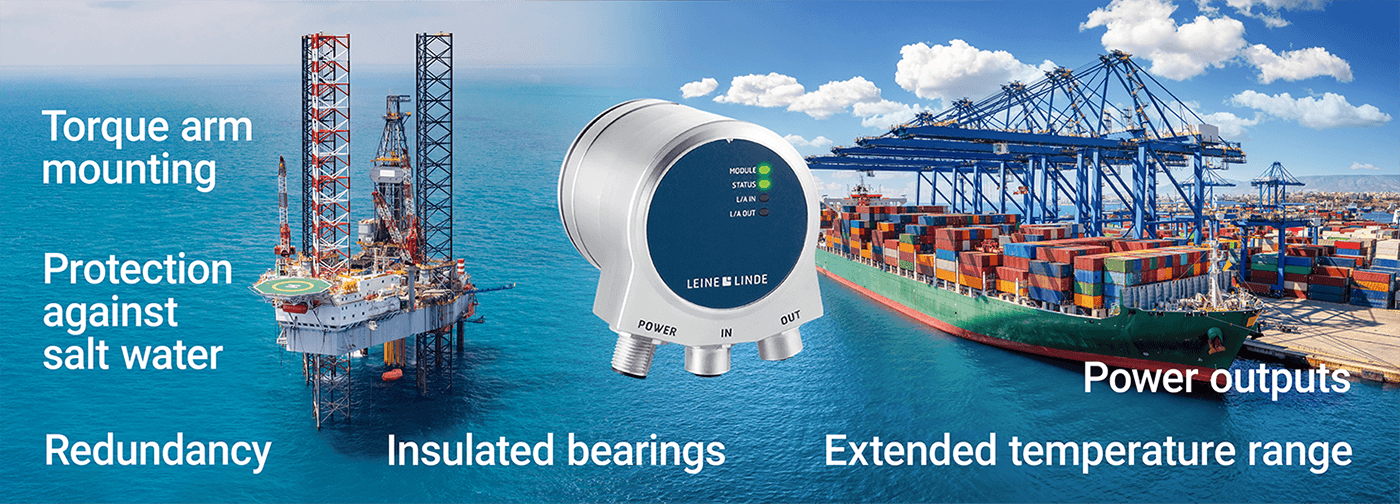
Encoders designed for marine use are built differently. With robust housing, sealed designs, and materials suited for harsh conditions, these marine encoders are engineered not just to function—but to endure.
Motion feedback across the vessel
Across a modern vessel, motion feedback supports far more systems than many realize. From propulsion and steering to cargo handling and navigation, encoder technology plays a role in maintaining precision, safety, and operational efficiency throughout the ship.
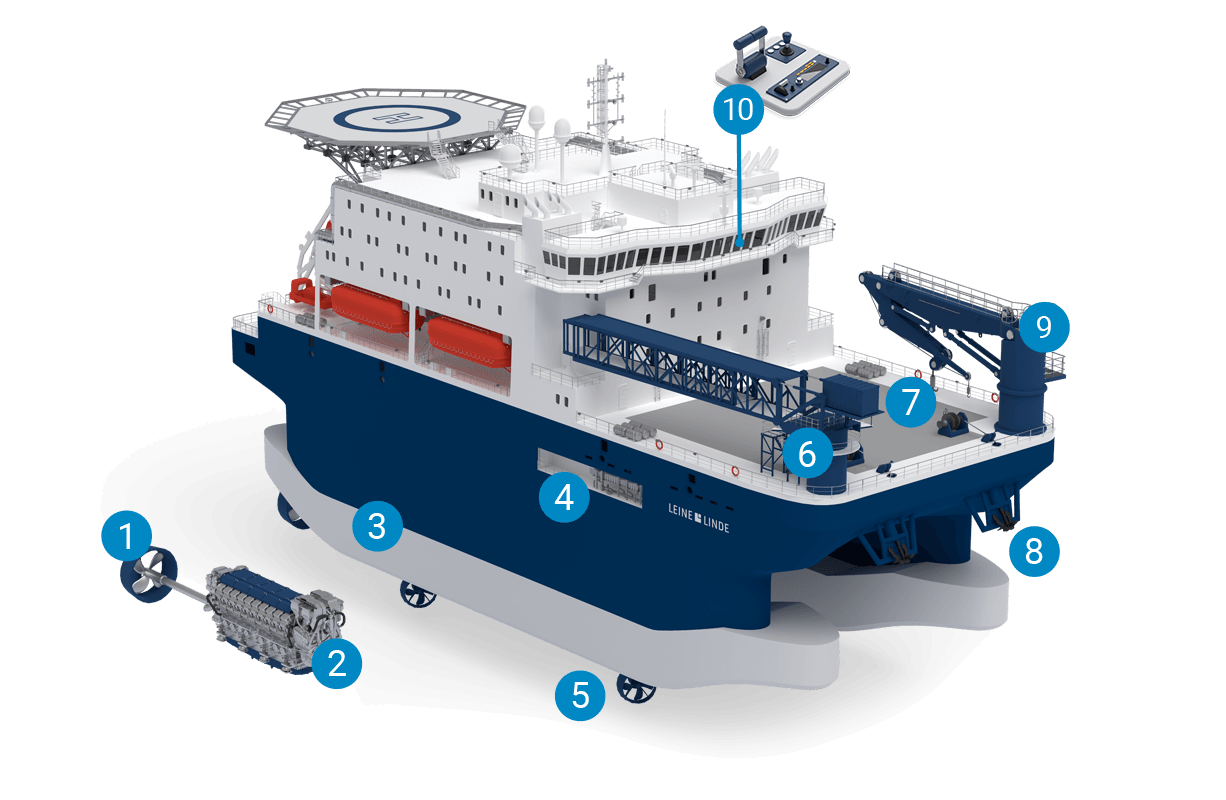
Encoder integration points across a marine vessel, supporting propulsion, steering, cargo handling, and navigation systems.
Below is a breakdown of how encoder technologies from the HEIDENHAIN family of brands are applied across these systems, delivering reliable offshore encoder solutions across critical vessel operations.
1. Steering systems
Accurate steering depends on precise position feedback. Encoders monitor rudder or steering wheel position, enabling both autopilot systems and manual control to respond accurately. This ensures stable navigation and improved vessel handling, even in challenging sea conditions.
Typical solution: 600 Industrial series
2. Power Take-Off (PTO) systems
Encoders measure rotary speed in PTO systems, that transfer engine power to auxiliary equipment, such as hydraulic systems or deck machinery. Reliable speed feedback ensures efficient power distribution and consistent system performance.
Typical solutions: MRI 2200, MRI 2300
3. Stabilization systems
To reduce vessel roll and improve onboard stability, encoders track the position and movement of stabilizer fins or gyroscopic systems. This real-time feedback helps maintain balance and improves operational comfort and safety.
Typical solutions: 600 Industrial series, 700 Compact series
4. Cargo handling systems
Encoders are integrated into conveyors, transfer bridges, and cargo lifts to provide position and speed feedback. This enables automated control, improves loading efficiency, and enhances operational safety during cargo movement.
Typical solution: 600 Industrial series
5. Propulsion and azimuth thruster systems
In propulsion systems, encoders monitor the position and rotational speed of key components, including propellers and thrusters. On main diesel engines, they measure crankshaft position to optimize fuel injection timing and improve efficiency. These systems rely on heavy-duty marine encoders built for continuous operation in demanding offshore environments.
Typical solutions: 600 Industrial series, 700 Compact series, 800 Heavy Duty series
6. Gangways and transfer systems
Encoders provide precise feedback for lifting platforms and gangways used to transfer personnel and equipment. Controlled movement is essential for safe and accurate operation between the vessel and shore or offshore installations.
7. Winch systems
Winches rely on encoder feedback to monitor rope or cable movement during towing, mooring, and lifting operations. This ensures accurate control and proper tension management underload.
Typical solutions: 700 Compact series, 900 Premium series
8. Anchor handling systems
Encoders track anchor deployment and retrieval, providing feedback on position, chain length, and tension. This enables safe and efficient anchoring operations in demanding offshore environments.
Typical solution: M500 series
9. Crane and davit systems
Encoders monitor crane boom position, hoist movement, and trolley positioning to support precise cargo handling. They are also used in davit systems to safely launch and retrieve rescue boats or equipment.
Typical solutions: 800 Heavy Duty series, FSI 900
10. Navigation systems
Encoders support navigation by monitoring the rotation of radar antennas and satellite communication systems. Accurate feedback ensures proper alignment and reliable tracking.
Typical solution: 500 Robust series
Choosing the right encoder technology
Selecting the right encoder depends on system requirements and control architecture.
Incremental encoders provide relative position and speed information through pulse signals and are commonly used in continuous motion applications.
Absolute encoders provide a unique position value for every shaft position, allowing systems to know their exact location immediately upon startup—an important advantage in critical marine systems.
Both technologies are widely used across marine applications, often working together to support different aspects of system control.
Built for integration and long-term operation
Marine vessels are long-term assets that operate for decades. As systems evolve, the ability to retrofit and upgrade equipment becomes essential.
Encoder solutions from HEIDENHAIN and Leine Linde are designed with flexibility in mind, offering:
- Multiple mounting configurations for easy integration
- Broad interface compatibility for existing control systems
- Durable designs suited for both new builds and retrofits
- Condition monitoring options to support predictive maintenance
These capabilities allow operators to extend equipment life, improve system performance, and reduce unplanned downtime.
Advancing marine performance through precision engineering
The marine industry continues to evolve, driven by increasing demands for efficiency, automation, and reliability.
Motion feedback remains a foundational technology in this transformation.
By combining precision measurement expertise with rugged, application-specific engineering, the HEIDENHAIN family of brands delivers solutions that help marine systems operate with greater accuracy, efficiency, and confidence.
For marine businesses, the result is clear:
- Improved operational performance
- Reduced maintenance risk and downtime
- Greater control over critical systems
- Long-term reliability in harsh environments
A trusted approach to marine reliability
At sea, performance is measured over time.
It is not just about how systems perform in ideal conditions, but how they continue to operate under stress, exposure, and continuous use.
With decades of experience and technologies built specifically for demanding environments, HEIDENHAIN and Leine Linde provide motion feedback solutions that marine operators can rely on—day after day, system after system.
Contact HEIDENHAIN to identify the right encoder solution for your marine systems and take the next step toward improved performance and reliability at sea.