


 Email
Email Print
PrintWhat is the Maximum Shaft Force Allowed by an Angle Encoder?
By Kevin Kaufenberg, HEIDENHAIN Product Manager
One of the most common questions we are asked from engineers who are designing angle encoders with a bearing and a through-hole into their rotary tables/stages is: "What is the maximum amount of force from the shaft that the encoder can handle?"
It is a critical question, as we know the more force applied to high-end bearings causes them to wear out faster. There is an equation that tells us how much inaccuracy results when there is eccentricity of the angle encoder graduation and reader head relative to the bearing. The equation is DF=+/- 412(e/D), where DF is the measuring error in arc seconds, and it equals a unit constant 412 times the quantity e (eccentricity in microns) divided by D (the graduation centerline diameter in millimeters). The equation basically tells us that for every 1 micron of eccentricity, the result is ~5 arc seconds of error.
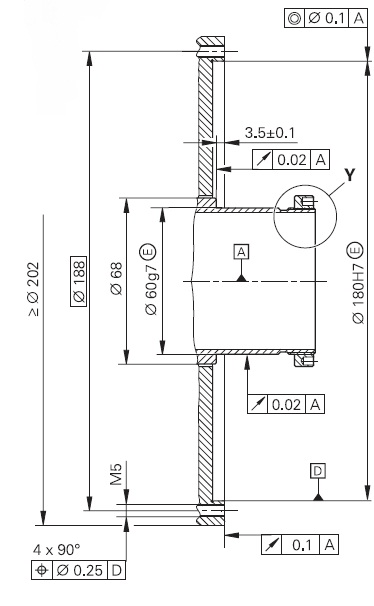
A customer's shaft can have runout and thereby induce a force onto the mating through-shaft of the encoder and onto the bearings inside the encoder. But HEIDENHAIN does not specify a minimum nor maximum force in Newtons that can be applied to the bearing. The reason is simply that the bearings should be exposed to as little force as possible. In the example above, even 1 micron of runout will cause 5 seconds of error, which is too much error for our angle encoders that have a system accuracy guarantee of +/- 1, 2 and 5 seconds.
Thankfully, the internal design of HEIDENHAIN's angle encoders to allow for some displacement resulting from shaft runout. In the drawing, it is shown that the axial and radial maximum runout or displacement is 20 microns, while still providing +/- 1 arc second encoder accuracy. The internal design, where the reader head is connected to an integrated internal coupling, is key.
The drawing shows a customer's shaft and base mounting dimensions to interface into HEIDENHAIN's RCN 700/800 series, which is a +/- 1 arc second accurate encoder. The shaft should be machined to a 60mm g7 spec. Taking that into account, the maximum runout for axial and radial is then set to 20 microns relative to bearing center A. It is probably easier for customers to use a dial indicator to measure their shaft runout in microns then to make force measurement.